

Introduction
Understanding what colors can dogs see isn’t just a curiosity — it affects how they experience the world. From choosing the right toys, picking safe outdoor colors, to simple training cues, knowing their visual limitations and strengths helps you make life easier and more engaging for your furry friend.
The Myth: Do Dogs See Only in Black and White?
For a long time, many people believed dogs saw the world in black, white, and shades of grey. Movies and cartoons even portray dog vision that way. But modern science has largely debunked that myth. Dogs do see colors — but far fewer than humans.
Still, the myth persists. That’s why it’s important to understand what really goes on in your dog’s eyes.
How Human Eyes Differ from Dog Eyes

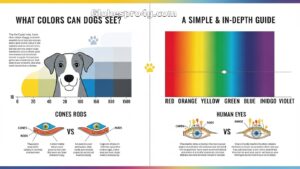
Humans generally have three types of color receptors, called “cones,” in their eyes. These cones let us detect a wide range of colors by picking up different wavelengths of light — roughly red, green, and blue.
Dogs, on the other hand, have only two kinds of cones. Because of this difference, their color vision is more limited and structured differently than ours.
What “Cones” and “Rods” Mean for Color Vision
- Cones are the cells in the retina responsible for detecting color — in bright light.
- Rods are more sensitive in low light, and they help detect motion and shape rather than color.
Since dogs have fewer cones and more rods compared to humans, their night vision and motion detection are often stronger than their color vision.
So while a rainbow may appear vivid to you, for a dog the world is likely more muted — especially in dim light.
Dichromatic Vision — What It Means for Dogs
Because dogs have only two types of cones, their eyesight is described as dichromatic (two-color) vision. This is similar to humans who have a certain type of color blindness — specifically red-green color blindness.
That doesn’t mean a dog’s world is black and white — far from it. But their perception of colors is different and limited compared to the full spectrum humans enjoy.
The Actual Colors Dogs Can See
Based on decades of research, here’s what scientists believe dogs can see:
- Blue — Dogs can clearly distinguish shades of blue and even perceive violet and purple hues as variations of blue.
- Yellow — Yellow is another color dogs see well. It remains part of their visible spectrum.
- Shades of Gray / Brownish-Grey / Muted Tones — For many colors outside blue and yellow, especially reds and greens, dogs likely perceive them as various shades of gray, brown, or muted — rather than bright colors.
In simpler terms: blue and yellow are the main colors dogs reliably see — plus different shades of gray and muted tones.
Colors Dogs Likely Can’t See or See Poorly

Given their dichromatic vision:
- Red, orange, and many greens appear dull or washed out — likely brownish, yellowish, or gray.
- Purples, pinks, and other tricky hues — even if humans see them vividly — are often translated by a dog’s eye into something closer to blue, gray, or brown.
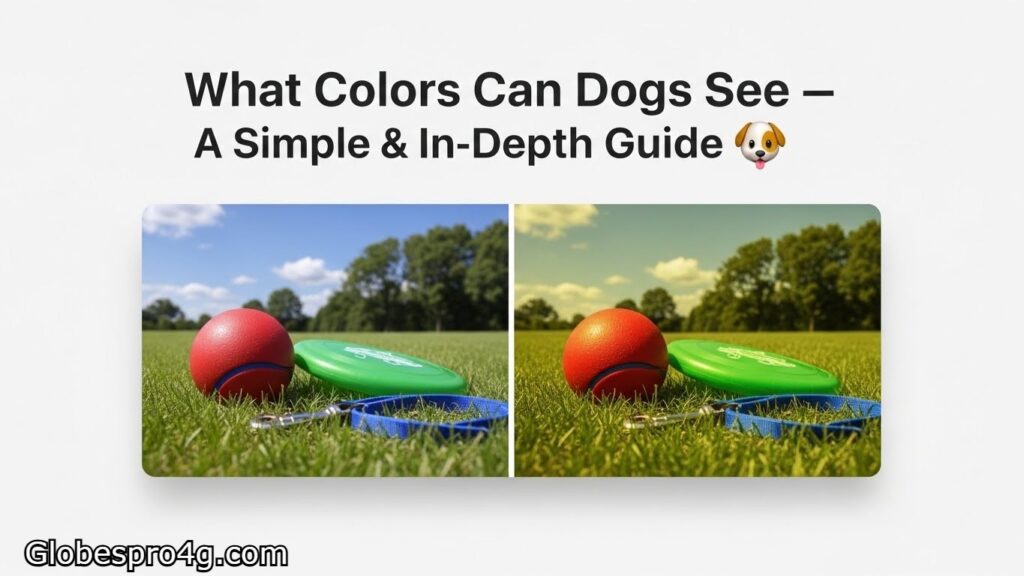
So that bright red ball you like so much? To your dog, it might look like a dull brown or gray blob — especially if it’s thrown on green grass.
What the World Looks Like to a Dog (Compared to Us)
If you could peek through your dog’s eyes, here’s roughly what you might notice:
- The world would be somewhat muted — fewer vibrant reds, greens, purples.
- Blues and yellows might stand out — like a blue toy on grass or a yellow ball in a yard.
- Many objects might blur together if they rely on red/green contrast (for example: a red frisbee on green grass might not stand out).
- Detail and distance clarity might be reduced — dogs generally don’t see as sharply as humans.
- Because they have more rods and fewer cones, dogs’ night vision and motion detection are often better than humans — so while color is limited, movement and shapes may be very clear, especially in low light.
So although their world isn’t as rich as ours, dogs rely on many other senses — sight, smell, motion, contrast — to navigate and understand the world.
More Than Color — Other Strengths of Dog Vision
Color vision is just one part of how dogs see the world. Their eyes are adapted for:
- Motion detection: Dogs can notice movement much better than humans, which helps them hunt or track objects.
- Low-light vision / Night vision: Thanks to more rods and a specialized structure behind their retina (called the tapetum lucidum), dogs see better in the dark than humans do.
- Smell integration: Dogs rely heavily on scent. While their vision gives cues about shape and movement, their sense of smell often guides them — especially when color information is limited.
Because of these strengths, dogs don’t really miss out — their sensory world is simply tuned differently.
Why Blue and Yellow Toys Are Better for Dogs

If you want to pick toys or objects that stand out to your dog:
- Choose blue or yellow — these colors they see well.
- Avoid bright reds, greens, or oranges — they may blend with the background (e.g. grass) or look dull.
- For outdoor play (on grass, dirt, or mixed background) a blue or yellow toy may be easiest for your dog to notice, track, and retrieve.
This simple insight can make games like fetch or training much more effective — and fun for your dog.
How Lighting and Time of Day Affect What Dogs See
Because dogs rely on rods (for low-light vision) more than cones, their ability to distinguish color is best under good lighting conditions — bright daylight or well-lit rooms.
At dawn, dusk, or during the night, the color component of vision becomes less relevant — and dogs rely more on motion, shape, brightness, and scent.
So if you want your dog to notice a toy color or object color, brighter light helps.
Why Dogs May Struggle with Red or Green on Grass
Think about a red ball thrown on a green lawn. To us, it’s easy to spot — bright red against lush green. But to a dog:
- The red may look brownish or grayish.
- The green grass may also appear as dull brown or muted yellowish-green.
- The red ball might blend in, making it hard for the dog to distinguish it visually.
That’s why many dog owners have seen their dog “miss” a red toy on grass — it’s not camouflage in the human sense, but simply low contrast in a dog’s vision.
Bonus: Dogs Might See Ultraviolet (Surprising Insight)
Some research suggests that the lenses in a dog’s eyes transmit significant amounts of ultraviolet (UV) light, which human eyes block. That raises the possibility that dogs perceive a portion of the spectrum invisible to humans. If true (and not confirmed for all dogs), that could add nuance to their vision: textures, patterns or markings invisible to us might stand out to them under certain lighting.
However — this is still an area under research, and we can’t say exactly what dogs “see” in UV. But it’s a fascinating reminder that their vision may be more complex and different than simply “blue/yellow/gray.”
Practical Tips for Dog Owners & Pet Parents
Here are some tips for using what we know about dog color vision to improve your dog’s life:
- Choose blue or yellow toys — especially for fetch or outdoor games.
- For objects you want your dog to see (training targets, markers, frisbees), avoid red or green.
- Use good lighting — bright daylight or well-lit rooms — to help them distinguish shapes and colors better.
- Rely more on motion, sound, and scent — dogs naturally combine senses; don’t over-rely on color alone.
- Be mindful of background colors (like grass or dirt) when picking toys — ensure good contrast to help your dog spot them.
What Color Vision Means for Dog Training & Play
Putting all this together:
- Training using visual cues — like pointing at colored objects — works best when the objects are yellow or blue (or high-contrast against background).
- When using toys for fetch or chase — yellow or blue balls/frisbees will likely be easier for your dog to spot and track.
- Indoor games with toys of contrasting colors or textures might work better than relying on color contrast alone.
- Understanding that dogs see fewer colors helps you avoid frustration when they seem uninterested — maybe it’s not that they don’t want to play, but that they simply don’t see what you see!
Conclusion
So, what colors can dogs see? The short answer: blue, yellow, and shades of gray or muted tones — at least in most cases. Reds, greens, purples, and many bright hues that we enjoy likely appear dull or washed out to them.
But that doesn’t mean dogs live in a dull, colorless world. Their vision is optimized differently: they see motion brilliantly, navigate low light easily, and combine their surprisingly strong sense of smell with their vision to perceive the world in ways we can’t fully imagine.
By recognizing and respecting those differences — choosing toys accordingly, adjusting our expectations, and appreciating their sensory strengths — we can build a richer, more enjoyable life for our canine companions.