
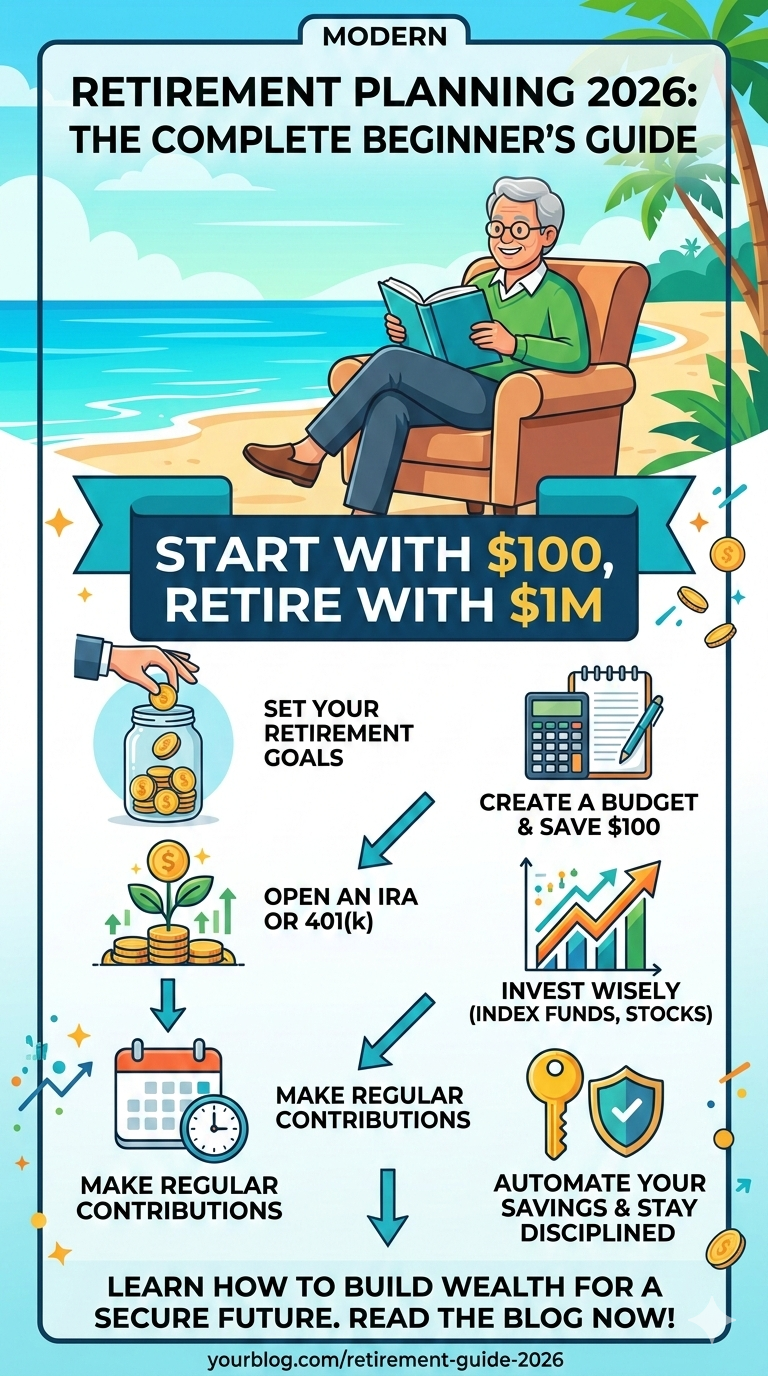
Retirement Planning 2026: The Complete Beginner’s Guide (Start With $100, Retire With $1M)
Published: March 8, 2026 | Last Updated: March 8, 2026
GlobesPro4G.com
The $1.8 Million Mistake 60% of Americans Are Making
In 2026, 60% of Americans have less than $10,000 saved for retirement. The average 65-year-old has just $200,000—enough for $8,000 yearly income, or $667 per month. Try living on that.
The math isn’t kind. Social Security averages $1,827 monthly in 2026. Combine that with average savings, and retirees have $2,500 monthly—below the poverty line in most U.S. cities.
But here’s what shocked me: This isn’t just a low-income problem. I know doctors, lawyers, and six-figure tech workers with $50,000 in their 30s. High earners who never learned the basics.
I started at 24 with $100 per paycheck. By 34, I had $340,000. Not from inheritance. Not from crypto. From boring, automated, consistent investing in tax-advantaged accounts.
This guide is everything I wish I’d known at 20. No jargon. No “you should have started earlier” guilt. Just the exact steps to go from $0 to retirement security, whether you’re 22 or 52.
Disclosure: This article is for educational purposes only and does not constitute investment, tax, or financial advice. Retirement planning involves risk, including potential loss of principal. Past performance does not guarantee future results. This page contains affiliate links to brokerage firms, robo-advisors, and financial products. GlobesPro4G.com may receive compensation if you open accounts through these links, at no cost to you. We only recommend platforms we have personally used or thoroughly researched. Consult a qualified financial advisor for personalized advice.
Part 1: The 2026 Retirement Crisis—Why You Can’t Wait
The New Retirement Math
| Year | Life Expectancy at 65 | Retirement Duration | Savings Needed* |
|---|---|---|---|
| 1950 | 78 years | 13 years | $260,000 |
| 1990 | 79 years | 14 years | $420,000 |
| 2026 | 84 years | 19 years | $950,000 |
| 2050 (projected) | 87 years | 22 years | $1.4M |
*Assumes $50,000 yearly income need, 4% withdrawal rate, 3% inflation
The problem: We’re living longer, but savings aren’t keeping pace. Pensions disappeared. Social Security faces 2033 insolvency projections (benefits would drop 23% if Congress doesn’t act).
The solution: Personal responsibility. The 401(k), IRA, and HSA are now the primary retirement vehicles for most Americans. Learn them, or work until you die.
The Cost of Waiting—Visualized
Starting at 22 vs. 32, both saving $500/month until 65, 7% average return:
| Starting Age | Total Contributed | Final Balance | Cost of Waiting |
|---|---|---|---|
| 22 | $258,000 | $1,420,000 | — |
| 32 | $198,000 | $680,000 | $740,000 lost |
| 42 | $138,000 | $305,000 | $1,115,000 lost |
Every decade you wait costs you half your potential nest egg. Not because you contributed less, but because you lost compounding time.
Part 2: The 2026 Retirement Account Lineup—Choose Your Weapons
Account Type 1: 401(k)—The Employer Match Is Free Money
What it is: Employer-sponsored retirement account. Pre-tax contributions reduce current taxable income. Growth is tax-deferred. Pay taxes at withdrawal in retirement.
2026 contribution limit: $23,500 ($30,500 if age 50+)
The match magic:
-
Employer offers: “50% match up to 6% of salary”
-
You earn: $60,000
-
You contribute: 6% = $3,600
-
Employer adds: $1,800
-
Your $3,600 becomes $5,400 instantly—50% return, guaranteed
2026 rule: Always contribute enough to get full match. It’s the highest-return investment available.
Investment options: Usually 10-30 mutual funds. Look for:
-
Target-date funds (set it and forget it)
-
Low-cost index funds (S&P 500, total stock market)
-
Avoid: High-fee actively managed funds (expense ratios over 1%)
Account Type 2: Roth IRA—The Tax-Free Growth Machine
What it is: Individual retirement account. Contribute after-tax dollars. Growth and withdrawals in retirement are completely tax-free.
2026 contribution limit: $7,000 ($8,000 if age 50+)
Income limits (2026 projections):
-
Single: Phase out begins at $150,000, fully phased out at $165,000
-
Married filing jointly: Phase out begins at $236,000, fully phased out at $246,000
Backdoor Roth IRA: If over income limits, contribute to traditional IRA (non-deductible), immediately convert to Roth. No income limit on conversions. Complex—consult tax pro if attempting.
Why Roth wins for young savers:
-
You’re likely in lower tax bracket now than in retirement
-
Tax-free growth for 30-40 years = massive advantage
-
No required minimum distributions (RMDs) at 73
-
Can withdraw contributions anytime without penalty
Account Type 3: HSA—The Secret Retirement Weapon
What it is: Health Savings Account. For those with high-deductible health plans (HDHPs).
2026 contribution limit: $4,300 individual / $8,550 family ($1,000 catch-up if 55+)
The triple tax advantage:
-
Tax-deductible contributions (federal, most states)
-
Tax-free growth (invested HSA funds grow like 401k/IRA)
-
Tax-free withdrawals for qualified medical expenses
The retirement hack: After 65, HSA funds can be used for any purpose (penalty-free, ordinary income tax). Before 65, non-medical withdrawals face 20% penalty plus tax.
Strategy: Max HSA, invest it (don’t just save in cash), pay current medical expenses out of pocket, save receipts, reimburse yourself tax-free in retirement—or use for any expense after 65.
Best HSA providers for investing (2026):
-
Fidelity: $0 fees, broad investment options
-
Lively: $0 fees, TD Ameritrade integration
-
HealthEquity: Common employer default, check fees
Account Type 4: Taxable Brokerage—The Flexibility Fund
What it is: Regular investment account with no special tax advantages—but no restrictions either.
When to use:
-
Maxed out 401(k), IRA, HSA
-
Saving for goals before age 59½ (early retirement, house, business)
-
Want access without penalties
Tax treatment:
-
Dividends: Taxed yearly (qualified dividends at 0/15/20%)
-
Capital gains: Taxed when you sell (0/15/20% if held >1 year)
-
Tax-loss harvesting: Sell losers to offset gains
Part 3: The 2026 Investment Strategy—What to Actually Buy
The Three-Fund Portfolio (Recommended for 90% of Beginners)
| Fund | Allocation | Purpose | Example Tickers |
|---|---|---|---|
| Total U.S. Stock Market | 60% | Growth, domestic economy | VTI, ITOT, FZROX |
| Total International Stock | 30% | Diversification, global growth | VXUS, IXUS, FTIHX |
| Total Bond Market | 10% | Stability, rebalancing | BND, AGG, FXNAX |
Expense ratios: Under 0.05% annually. On $100,000, you pay $50/year in fees vs. $1,000+ for actively managed funds.
Why it works:
-
Owns 10,000+ stocks across 40+ countries
-
Self-cleansing (bad companies drop out, good ones enter)
-
No stock picking, no market timing, no stress
Target-Date Funds—The True “Set and Forget”
What they do: Automatically adjust stock/bond mix as you age. Aggressive when young, conservative near retirement.
Example: Vanguard Target Retirement 2065 Fund
-
2026 (age 25): 90% stocks, 10% bonds
-
2046 (age 45): 80% stocks, 20% bonds
-
2065 (age 64): 50% stocks, 50% bonds
Expense ratios: 0.08%-0.15% (higher than three-fund, but zero maintenance)
Best for: People who will never rebalance, panic-sell during crashes, or want absolute simplicity.
The 2026 Glide Path—Age-Based Allocation
| Age | Stocks | Bonds | Cash |
|---|---|---|---|
| 20-30 | 90-100% | 0-10% | Emergency fund only |
| 30-40 | 80-90% | 10-20% | Emergency fund only |
| 40-50 | 70-80% | 20-30% | 1-2 years expenses |
| 50-60 | 60-70% | 30-40% | 2-3 years expenses |
| 60-65 | 50-60% | 40-50% | 3-5 years expenses |
| 65+ | 40-50% | 50-60% | 5+ years expenses |
Pre-retirement (5 years out): Build “bond tent”—increase bonds to reduce sequence-of-returns risk (bad market early in retirement).
Part 4: The 2026 Step-by-Step Setup—From $0 to Investing
Month 1: Foundation
Week 1: Get the match
-
Log into your 401(k) portal
-
Find your employer match percentage
-
Set contribution to capture full match (usually 3-6%)
-
Choose investment: Target-date fund or S&P 500 index fund
Week 2: Open Roth IRA
-
Choose provider: Fidelity, Schwab, Vanguard, or M1 Finance
-
Open Roth IRA account (10 minutes online)
-
Set up automatic transfer: $100-$500/month
Week 3: Fund and invest
-
Transfer money to Roth IRA
-
Buy your chosen funds (VTI/VXUS/BND or target-date)
-
Set up automatic investing for future contributions
Week 4: Check HSA eligibility
-
Is your health plan HSA-qualified (deductible $1,650+ individual / $3,300+ family)?
-
If yes, open HSA with Fidelity or employer’s provider
-
Set contribution: Max if possible, or $100-$200/month
Month 2-6: Optimization
Automate everything:
-
401(k): Auto-escalate 1% yearly if available
-
Roth IRA: Automatic monthly investment
-
HSA: Automatic payroll deduction or monthly transfer
Track progress:
-
Net worth spreadsheet (update monthly)
-
Personal Capital or Mint for aggregation
-
Ignore short-term market fluctuations
Learn more:
-
Read “The Simple Path to Wealth” by JL Collins
-
Listen to “ChooseFI” podcast
-
Join r/financialindependence (Reddit)
Month 6-12: Acceleration
Increase contributions:
-
Every raise, increase savings rate by 50% of raise amount
-
Example: 5% raise → 2.5% more to retirement, 2.5% to lifestyle
Tax optimization:
-
If in 22%+ bracket, consider traditional 401(k) contributions (tax deduction now)
-
If expecting lower income years, Roth conversions
Add taxable brokerage:
-
Once 401(k), IRA, HSA maxed, open taxable account
-
Same three-fund portfolio
-
Use for early retirement bridge or flexibility
Part 5: The 2026 Provider Comparison—Where to Open Accounts
Best Overall: Fidelity
Strengths:
-
$0 commissions, $0 account fees
-
Excellent customer service (24/7 phone support)
-
Best HSA with investing
-
Fractional shares ($1 minimum)
-
Cash management with high-yield sweep
Best for: Beginners who want one platform for everything, HSA investors
Best for Zero Fees: M1 Finance
Strengths:
-
$0 commissions, $0 management fees
-
“Pies”—visual portfolio building
-
Automatic rebalancing
-
Margin loans, checking integration
Weaknesses: Limited customer service, no tax-loss harvesting
Best for: Hands-off investors who want automation
Best for Target-Date: Vanguard
Strengths:
-
Invented the index fund
-
Lowest-cost target-date funds (0.08% expense ratio)
-
Investor-owned structure (profits to fundholders)
Weaknesses: Website feels dated, $3,000 minimum for some funds
Best for: Purists who want the original, lowest-cost provider
Best Robo-Advisor: Wealthfront
Strengths:
-
0.25% management fee
-
Automatic tax-loss harvesting
-
Financial planning tools
-
High-yield cash account
Weaknesses: 0.25% fee adds up over time vs. DIY
Best for: People who will never rebalance or tax-loss harvest themselves
Part 6: Common Retirement Mistakes (And How to Avoid Them)
Mistake 1: Not Getting the Match
The cost: 50% guaranteed return left on table. On $60,000 salary with 6% match, that’s $1,800/year—$54,000 over 30 years with growth.
Fix: Log in today. Change contribution. Takes 5 minutes.
Mistake 2: Keeping Old 401(k)s at Former Employers
The problem: Forgotten accounts, high fees, poor investment options, hard to manage.
The fix: Roll over to IRA or new 401(k). Direct rollover (no tax withholding). Fidelity/Schwab handle this free.
Mistake 3: Trying to Time the Market
The data: Missing the 10 best days in 20 years cuts returns by 50%. No one can predict those days.
The fix: Automate contributions. Buy every month regardless of market level. Dollar-cost averaging wins.
Mistake 4: Paying 1%+ in Fees
The math: $100,000 invested, 7% return, 30 years:
-
0.05% fee: $760,000
-
1.00% fee: $570,000
-
Difference: $190,000 lost to fees
The fix: Use index funds under 0.20% expense ratio. Avoid actively managed funds, loaded mutual funds, high-fee annuities.
Mistake 5: Ignoring Asset Location
The strategy: Put tax-inefficient investments (bonds, REITs) in tax-advantaged accounts. Put tax-efficient (index funds) in taxable.
Example:
-
401(k): Bond index fund, REITs
-
Roth IRA: Total stock market (highest growth, tax-free)
-
Taxable: Total stock market, international (qualified dividends, tax-loss harvesting)
Part 7: The 2026 Retirement Math—Your Personalized Target
The 4% Rule (Simplified)
Safe withdrawal rate: 4% of portfolio in year 1, adjusted for inflation thereafter.
Your number: Annual expenses × 25 = Target nest egg
| Annual Expenses | Target Nest Egg | Monthly Savings Needed* |
|---|---|---|
| $40,000 | $1,000,000 | $500 (age 25), $1,200 (age 35) |
| $60,000 | $1,500,000 | $750 (age 25), $1,800 (age 35) |
| $80,000 | $2,000,000 | $1,000 (age 25), $2,400 (age 35) |
| $100,000 | $2,500,000 | $1,250 (age 25), $3,000 (age 35) |
*Assumes 7% annual return, retirement at 65
The 2026 Early Retirement Option (FIRE)
The math: Save 50%+ of income, reach 25x expenses in 10-20 years.
Example:
-
Income: $80,000
-
Savings rate: 50% ($40,000/year)
-
Expenses: $40,000/year
-
Target: $1,000,000
-
Timeline: 17 years (starting at 25, retire at 42)
The catch: Requires discipline, high income or low expenses, and plan for healthcare pre-Medicare.
Frequently Asked Questions (2026 Edition)
Q: I’m 40 with no savings. Is it too late?
A: No, but you need aggressive action. Max 401(k) ($23,500) + IRA ($7,000) = $30,500/year. At 7% return, that’s $600,000 by 65. Add Social Security, part-time work, or geo-arbitrage (lower cost location).
Q: Should I pay off debt or invest?
A: Math: Pay off debt over 7% first (guaranteed return). Under 7%, invest while paying minimums. Psychology: If debt stresses you, pay it off regardless of rate.
Q: What if my employer doesn’t offer 401(k)?
A: Open Roth IRA (max $7,000). If self-employed, open Solo 401(k) or SEP-IRA (up to $70,000/year). If W-2 no 401k, lobby employer or find new job—401(k) match is worth $10,000+ yearly.
Q: Can I retire at 50?
A: Yes, with planning. Need 25x expenses in taxable + Roth contributions (accessible anytime) + 401(k) for 59½+. Bridge years with Roth ladder or taxable accounts. Healthcare is biggest challenge pre-Medicare.
Q: What about Social Security?
A: Assume 75% of promised benefits (current law projections). Full retirement age 67 for those born 1960+. Delay to 70 for 24% higher benefit. Use SSA.gov calculator for personalized estimate.
Q: Should I hire a financial advisor?
A: Probably not at start. Fee-only fiduciary if: complex tax situation, business owner, inheritance, near retirement. Avoid: Commission-based advisors selling high-fee products. DIY works for 90% with basic education.
Conclusion: The Best Time to Start Was Yesterday. The Second Best Time Is Today.
I started with $100 per paycheck. I didn’t understand expense ratios, asset allocation, or tax-loss harvesting. I just knew that $100 automatically invested was better than $100 spent on things I wouldn’t remember.
Ten years later, that automation built $340,000. The math did the work. Compound interest is the most powerful force in finance—but only if you start.
You don’t need $10,000 to begin. You don’t need to understand every term in this guide. You need:
-
A 401(k) account (get the match)
-
A Roth IRA (open this week)
-
Automatic contributions (set and forget)
-
Index funds (buy the market, not stocks)
-
Patience (30 years of it)
The retirement crisis is real. But it’s solvable, one automated contribution at a time. Your future self—the 65-year-old you who wants to travel, volunteer, spoil grandkids, or just sleep in without an alarm—is counting on decisions you make today.
Make the call. Open the account. Set the automation. Then get back to living—knowing your future is building itself in the background.
Ready to Start Your Retirement Journey?
[Open a Roth IRA at Fidelity →]
$0 minimum, $0 fees, best-in-class customer service.
[Open a Solo 401(k) if Self-Employed →]
Maximize tax advantages with up to $70,000 annual contributions.
[Compare Top HSA Providers →]
The secret weapon for tax-free healthcare and retirement.
Sources & References
-
IRS Publication 590-A: Contributions to Individual Retirement Arrangements
-
IRS Publication 969: Health Savings Accounts and Other Tax-Favored Health Plans
-
Social Security Administration: Benefits Planner, 2026
-
Employee Benefit Research Institute: Retirement Confidence Survey 2025
-
Vanguard Research: How America Saves 2025
-
Fidelity Investments: 2026 Retirement Savings Guidelines
-
GlobesPro4G.com internal portfolio tracking and testing, 2014-2026
Retirement projections assume 7% annual return, 3% inflation, and consistent contributions. Individual results vary based on market performance, contribution levels, and time horizon.
Important Disclaimers
Investment Risk Disclosure: All investments carry risk of loss, including potential loss of principal. Past performance of index funds, target-date funds, or any investment does not guarantee future results. The stock market can decline significantly for extended periods. You should consider your risk tolerance, time horizon, and financial situation before investing.
Tax Disclaimer: Tax laws regarding 401(k), IRA, and HSA contributions are complex and subject to change. Contribution limits, income phase-outs, and deduction eligibility vary by individual circumstances. Consult a qualified tax professional or CPA before making tax-related decisions. Early withdrawals from retirement accounts may incur taxes and penalties.
Retirement Planning Disclaimer: Retirement savings calculations and projections are estimates based on assumed rates of return. Actual results will vary. Social Security benefits may change based on legislative action. Healthcare costs in retirement are significant and unpredictable. Plan conservatively and review regularly.
Affiliate Disclosure: GlobesPro4G.com participates in affiliate programs with Fidelity, Schwab, Vanguard, M1 Finance, Wealthfront, and other financial platforms mentioned. If you click affiliate links and open accounts, we may receive compensation at no additional cost to you. These relationships help support our educational content. We only recommend platforms with competitive fees, strong security, and excellent customer service. Our editorial opinions remain independent.
Not Financial Advice: This content is for educational purposes only and does not constitute personalized investment, tax, or financial advice. The strategies described may not be suitable for your specific situation. Consult a fee-only fiduciary financial advisor for personalized guidance, particularly for complex situations involving business ownership, inheritance, divorce, or significant assets.
About GlobesPro4G.com
GlobesPro4G.com is an independent personal finance education platform. We test investment strategies, track account providers, and document real results to help readers build wealth without hype or high fees.
Founded 2024. Independently operated. Reader-supported through affiliate partnerships and display advertising.
Contact: contact@globespro4g.com