

Introduction
The tech and digital world are ever growing, bringing us new ideas and platforms to change how we engage with information and people. One such neologism that has caught people’s imagination is “nometre”. If you’ve seen this word and scratched your head about what it means, you’re not alone. The following guide is intended to be a nometre demystifier: a detailed exploration of where it came from, what we use it for now, and the enormous effects that it’s starting to generate in many areas. We’ll get a sense of what challenges it’s designed to solve and why it’s rapidly becoming relevant for the pro, creator, and consumer alike. And I can assure you that this research will give you a good understanding to allow you to understand not only the “what,” but also the “why” of this trend.
What exactly is Nometre?

Fundamentally nometre is a new way to structure and engage with digital content. It is a model that is not based on hierarchical file system or on linear I/O, as traditionally done. It’s a multiple dimension handling of data powered by context, relationships and relevancy, not just the data itself. As opposed to keeping a file in a single folder, nometre allows information to exist in several interlinked nodes, thus generating a network of knowledge which is more natural and closer to the way brains store and transfer data. This system isn’t a product, it’s a principle that can be applied to many things including personal knowledge management systems and large-scale enterprise data architecture. It prioritizes a non-linear, associative structure that allows information to be discovered and used in the most effective way.
Nometre Concept, History and Evolution
Nometre was not an idea that just came out of nowhere. It had its roots in decades of work in computer science, cognitive psychology and information theory. Early thinking on hypertext and non-linear contructs of knowledge were the province of visionaries like Vannevar Bush who came up with his “Memex” idea in the L940’s. They were early visions of an apparatus in which every man, woman or child could carry all their books, records and communications, and which would be so compounded that it could be consulted with exceeding ease and speed. The creation of the internet and World Wide Web provided a stepping stone to these theories, but they worked primarily with one-way pathways. Nometre expands that past work by providing a richer, multi-directional, and contextualized framework for connecting and arranging the data, progressing from a simple web of pages to an interwoven meadow of ideas.
Principles of the Nometre framework
Nometre Basics There are a number of basic concepts that guide the nometre approach and set it apart from other data management systems. The first is associative linking, that any body of information can link to any other in a meaningful way and not form the hard tree of “folders” but rather be a network of related concepts. A third principle is contextualization - what context are you in and how that data presents it. Which is to say, the same bit of data might appear or behave differently, based on what it volunteered to do when it was queried. And third, decentralization is usually a theme, which enables data to be dispersed among many locations with no central point of failure, providing better security and putting the user at the center. Combined, they provide a system that is flexible, smart and highly personalised to individual requirements.
Point-to-Consider Regarding Nometre in contrast with Regular File Systems

Let’s compare nometre directly to the way we’ve become accustomed to working with files and folders, so you can really see how much of an upgrade it is. A traditional system, such the desktop on your computer, is hierarchical. A document has to exist in a folder, that may be inside another folder, and so on. That’s what makes for a top-down, controlling organization. If you want to tag a file with two tags — say, report on “Project Alpha” and “Q4 Financials” — then you have to either make a copy of the file or else create a shortcut. Nometre eliminates this limitation. The same report can be a node that attaches itself to ”Project Alpha” or alternatively “Q4 Financials” without creating a copy of itself. This networked strategy allows you to locate information in terms of its relations and context, rather than remembering the top-level string that serves as a label it was stored under.
How Nometre Can Help with Personal Knowledge Management
For knowledge hungry and thought leaders, nometre is the most efficient personal knowledge manager (PKM) to organize our thoughts in never seen before way. Nometre tools make possible, activating a “second brain”: a digital twin of the user’s mind in which thoughts, notes and resources are linked into a web. Instead of linear note-taking apps and jumbled document folders, you can collaborate on a personal wiki where every concept is interconnected to other related concepts. That way it is easier to see patterns, glean new insights and find information when you need it most. Work smarter. If you’re a student working on your thesis, an author making an outline for their book or a professional keeping tabs on industry trends, adhering to a nometre system can turn jotted notes into an organized and empowered knowledge bank.
1 The Place of Nometre in O32 A synthetic micro-blogging experiment for unsynchronous cooperative editorial staffing
Besides being an individual tool, nometre has great potential for use by teams. Information tends to be siloed in a business — across various departments, scattered emaill inboxes and specialized project management tools. That makes it harder for team members to have a project-wide view, or access necessary information rapidly. A nometre-powered ecosystem has the potential to shatter these silos by providing an open, connected office space. A designer’s designs can be associated with a developer’s code, a marketer’s campaign brief and the finance team’s budget within the same place. This kind of contextual communication helps everyone to stay in the loop and understand how their contributions impact the larger vision, with a focus on transparency and increasing team efficiency.
Nometre Applications Education and Research

The scientific community too, academics pursue research and interdisciplinary ties heavily, so they will gain a lot from this model. It allows researchers to chart complex theories, trace citations and related studies, visualize the landscape of their field. For students, it can be an effective learning technique by challenging them to analyze how various topics and ideas come together that goes beyond rote memorization. Here’s an example: A teacher might design a curriculum that integrates historical happenings with scientific breakthroughs, cultural movements and lines of philosophical thought from the same era, offering students a more authentic learning experience that reflects how things are interconnected in real life.
Technical Architecture of a Nometre System explained
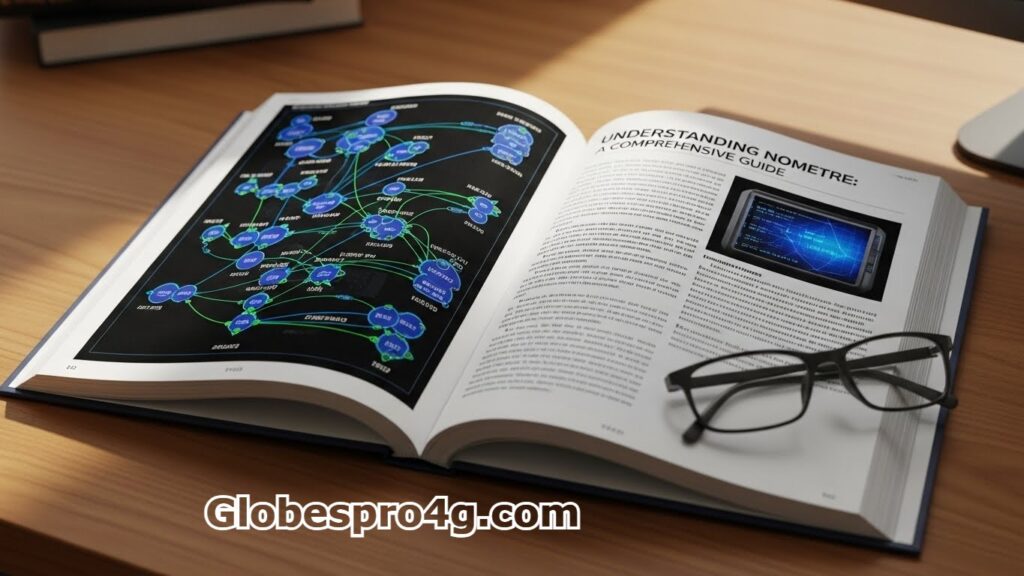
The nometre Concept The concept of the nometre is quite facile, however the architectural implementation of a nometre system is quite complex. It is often done in a type of database called a graph database, where the data are represented as nodes (or entities) and edges (or relationships). Nodes have different properties (attributes) and edges describe which type of relation the nodes have in common (e.g., “is related to”, “is a part of”, “contradicts”). This architecture is very flexible and scalable, it can handle complex queries impossible to do with relational databases. On the web of relationships The user interface form a nometre systems typically forms graph visualizations, so users can literally see how their data points are connected to one another, and explore our map of knowledge in an intuitive whiffling manner.
Introducing Nometre Tools: Initial steps with the first tool
If the potential of nometre has you excited, you are likely wondering how to get started using it. Its first step is to examine some of the tools that have been developed based on its principles. The likes of Obsidian, Roam Research, and Logseq are popular tools in the personal knowledge management niche. A lot of these are available in free or trial versions, so you can try them out to see if they’re the right fit for your production tech. Start by making simple notes and connecting them to one another. For instance, make a note for the book you’re reading, then create additional separate notes about key characters or themes and link them back to the main book note. You will be able to grasp how associative thinking can be incredibly powerful and how you want to work over time by starting small and growing your network of notes.
Nometre’s Future: What to look out for numberWithInt
Nometre is just getting started on its journey. With the continued development of AI systems, and as capabilities such as machine learning become more sophisticated, we can expect nometre products to be equally intelligent. In the future, these might automatically propose relevant links between notes (via semantic analysis), which could then help you discover connections that you otherwise wouldn’t. Integration The integration of other platforms and data sources will hopefully become smoother, so you can start to pull in information from emails, web articles and documents directly into your knowledge graph. The dream is a truly ambient, predictive system that just surfaces the right information at the right time, without you even needing to pull it up yourself — and this would change what relationship we have to digital information.
Potential Challenges and Limitations
However, the nometre technology is also hampered by several drawbacks. A possible downside is the learning curve. Users may find the transition from a plain folder structure to a networked graph to be somewhat disconcerting at first. It is a mindset change and an expression of doing data differently. A third concern is the possibility of a “tangled mess.” Without tagging and linking with a repeatable process, knowledge graphs are just as random as your desktop. Data portability can be another issue; the ease of exporting your complex web of notes from one nometre-based tool to another varies, and that potential vendor lock-in looms.
Nometre within the Creative Industries: A Fresh Canvas for Ideas
For writers, artists, designers and other creative individuals there is a new canvas for brainstorming and forming ideas in the form of nometre. A fiction writer can organize complex, sprawling plotlines and character relationships and world-building details in a visual web. The UX designer can connect user personas with journey maps, wireframes and user feedback, giving a complete image while working on the product. This non-linear format is ideally suited for the nonlinear, hectic thought process that often comes with imagination – in which ideas not only need space to have their own individual identities but also room to flow and connect like interlocking strings of thought that may never intersect at all (in a way linear documents or spreadsheets just can’t account for).
Nometre and Data Privacy Considerations
As with any system that processes sensitive or personal information, privacy is of utmost concern. CraftCMS Many nometre tools solve this by bending over backwards with local-first data storage. That is, your data resides mostly on your device rather than a company’s cloud server. This means that you are the sole owner of your information. For cloud and collaborative platforms, you will want to make sure that any file storage or data systems have strong security protections such as end-to-end encryption to keep your data secure from unauthorized users. As more and more of the nometre ecosystem develops, clear guidelines on data privacy and security will be key in winning the trust from users.
Is Nometre Right for You?

In the end, whether nometre is your solution depends on your specific needs and workflow. If you are dealing with a mass of connected information and feel like file systems keep you boxed in; if you think about the relationships between ideas as much as the ideas themselves, then nometre-based storage may be groundbreaking for you. Especially for researchers, writers, students and strategic planners. That said, if your needs are modest — for example, storing and retrieving standalone documents like photos or invoices — a good old shared folder system might still be all you need. I suppose the best way to learn would be to try one of these tools out and see if a networked tool complements your thinking.
Conclusion
The nometre conception is not just another software proposition; it is an indicator of a new way to consider digital information. It’s an intuitive, powerful way to make sense of the complexities in our digital lives by breaking out of hierarchies and embracing interconnected, contextual knowledge. While it is still an evolving field with obstacles to surmount, its ability to support personal creativity, facilitate team collaboration and extend knowledge through deep understanding of complex subjects is clear. The from-the-ground-up approach nometre applies will only become more and more important to making sense of that tidal wave, as we continue creating and eating information in amounts never before seen by humankind.
 Finixio Digital