

Introduction
When college football fans fantasize about high-profile matchups, there are certain pairings that come to mind right away. They’re the games that include storied programs, iconic uniforms and passionate fans. A game featuring the Michigan vs Auburn Wolverines and the Auburn Tigers would fit that bill. It’s a divergence from the normal rivalry lines, but also a collision of big-time Big Ten might and SEC meanness. This make-believe match up has everything, history, styles contrasts and all time greats that would be sure to put this on the map. To explore this matchup is to look beyond the one game and delve into the cultures of two of college football’s most revered programs.
The Pillars of Football Royalty: Michigan and Auburn

Michigan vs Auburn and Auburn both have illustrious spots in college football’s pecking order. The Michigan vs Auburn Wolverines, from Ann Arbor, are one of the sport’s original blue bloods. Their tradition is marked with national titles, Heisman Trophy winners and the largest stadium in the nation, “The Big House.” The winged helmet is one of the most identifiable symbols in all of sports, a symbol that stands for a tradition of excellence and type of tough, hard-nosed football. The Wolverines have been the symbol of the Big Ten for decades, also fighting for conference titles and national respect on a yearly basis.
Down in Auburn, Alabama there creates an own legend all around a Southeastern Conference (SEC) black forge. Running in the shadow of a state power has only served to stoke the flames of the ever faithful Auburn family, turning out some of the most passionate and unwavering program supporters in the nation. Jordan-Hare Stadium is turned into a noise cauldron on game days, thanks in large part to the “War Eagle” battle cry. There’s Auburn’s own national titles, Heisman winners and the program’s reputation for providing some of college football’s most thrilling and jaw-dropping moments — what it simply means to “Auburn being Auburn.”
Head-to-Head History: Short but Sweet
Despite their rich histories, Michigan vs Auburn and Auburn don’t have a very long series history. They have played on the gridiron just twice, with both meetings occurring in a January bowl game decades apart. The lack of occurrences between the two makes a potential future showdown even more interesting. Each game was a snapshot of the progams at that moment, an opportunity to see how the two very different styles of play stacked up on neutral ground. These games are more than historical footnotes; they’re the only real-world data points we have for this dynamic intersectional struggle.
The first meeting came in the 1984 Sugar Bowl, a battle between two top-10 teams. Bo Schembechler’s Wolverines and Pat Dye’s Tigers played a typical end for the era, a hard-hitting defensive grind. Auburn, with a freshman running back named Bo Jackson, ultimately won the close 9-7 game. The game was a perfect reflection of the philosophies of both coaches, defense and power running. It was a 7-6 slugfest that epitomized the grind-it-out football of its day and showed that little ol Auburn could run with the best teams from any conference.
The two teams faced off again almost two decades later in the 2001 Florida Citrus Bowl, in Orlando. This game was a different animal, featuring more offensive firepower. Michigan vs Auburn The Wolverines, led by head coach Lloyd Carr, traveled to face Auburn from the Southeastern Conference. In a tale of twists and turns, the Wolverines overcame the Tigers in dramatic fashion with a game-winning field goal as time expired to win 31-28. This game, headed by future NFL QB Drew Henson for Michigan, showed that a Michigan and Auburn meeting could be about offense as well, which would provide plenty of drama and excitement for the nation to witness.
Coaching Gymnastics: The Brains Behind the Machine

Any Michigan vs Auburn talk has be laced with coaching philosophies for the programs. The Michigan program has long been identified with a certain style of football, primarily due to legendary coaches such as Fielding Yost and Bo Schembechler. This philosophy is usually defined by a dominant OL, elite rushing attack and stingy detail-oriented defense. It is a style built on winning the game in the trenches and imposing your will upon the opponent. Even as modern offenses have changed, the identity of Michigan football frequently reverts back to these principles of toughness and control.
Auburn’s coaching identity, in turn, has often been more malleable and sometimes more explosive. Located in the heart of SEC country, Auburn coaches have had to be creative to remain competitive. Value a defense the way Tate does, and gradually you learn to savor underdog wins when you make them possible by tip-toed offensive efficiency against burly front sevens by turning every game into your “one chance.” This mentality to embrace offensive creativity with the usual SEC focus on speed and athleticism, in turn makes Auburn a dynamic and at times unpredictable presence on the field.
Comparing Player Recruitment and Development
The recruiting trail is where championships are won in the future and both Michigan and Auburn are major factors. But, their styles are also influenced by where they live or call the style of play that they grew up playing. Michigan is a recruiting hotbed in the Midwest and even has produced some good replays such as technical linemen and hard nosed football players out of states like Michigan vs Auburn and Ohio. The Wolverines are also a national recruiter, leveraging their academic reputation and global brand to draw talent from across the country, in places like Texas, California and Florida.
Auburns recruiting foundation is built upon fertile Southeast soil. States like Alabama, Georgia and Florida are fertile with elite athletic talent, particularly at the skill positions. Auburn’s success is tied to winning battles for elite defensive linemen, fast linebackers and offensive skill players that call this region home. That is a powerful lure for the Tigers in attracting players who want to test themselves against the best every single week, in what most consider as college football’s best conference.
The Ball Is Battle of the Stadiums: The Big House vs. Jordan-Hare
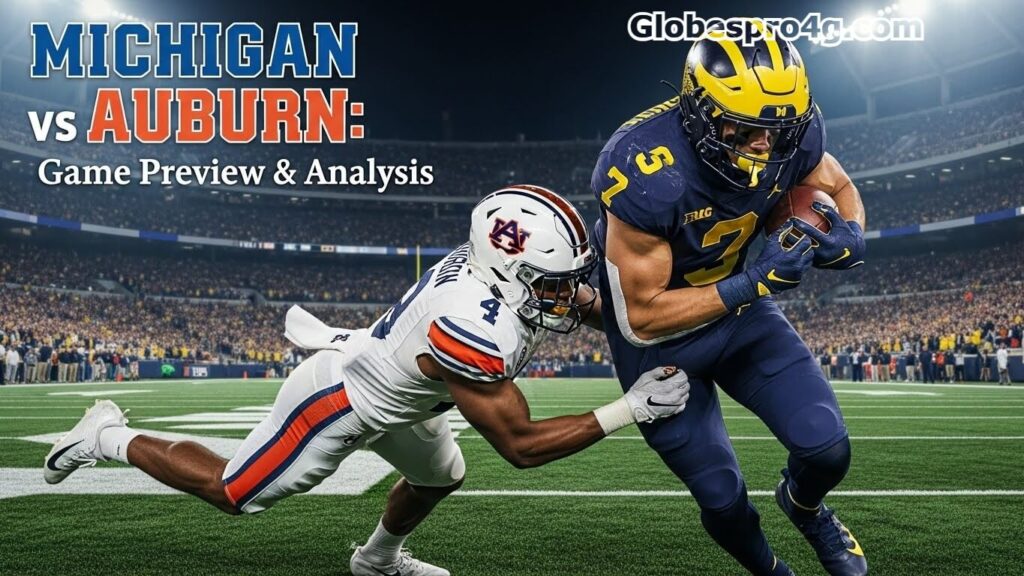
The home field “advantages” of these two schools could not be more contrasting, but just as horrifying to any visiting team. Michigan Stadium, universally known as “The Big House,” is a towering testament to the sport of football. The seating arrangement at the stadium makes it the largest by seating capacity in the United States. The stadium is simply large, and the sea of maize and blue intimidates. Not necessarily on a decibel-for-decibel level, but the sheer size of the crowd and the sense of history that hangs in its thick air can be suffocating to visitors.
The intensity in Jordan-Hare Stadium is of the otherworldly variety. It can be a surprisingly compact place even though — or maybe because — it’s considered an architectural monstrosity; capacity is more than 87,000 at that taller-than-wide stadium, where noise collects and launches itself straight onto the field. As you know the Auburn Student Section is loud and rowdy making it a hostile environment from opening kick to 0:00. Pre-game, the Tiger Walk incites the masses and leads for multiple Instagram pic opportunities — so you can try upping your selfie game several times before kickoff. Ask any team that has visited there, and they will advise you that a night game at Jordan-Hare is one of the most difficult experiences in all of college football.
OUTLOOK Offensive Styles: Big Ten Grind vs. SEC Speed
A potential Michigan vs Auburn game would be an interesting matchup of versions of the offense. Michigan’s offensive identity is routed in a pro-style system that runs to set up the pass. The idea is to own the time of possession, pound away with a physical offensive line and eliminate costly mistakes. This is a methodical formula to win games by wearing on teams, but it also keeps the ball away from an opponent and then takes its best advantage when they are exhausted in the fourth quarter. It’s an aesthetic that values substance over glitz — and it has done wonders for the show.
Auburn frequently compares this to an offense predicated on speed and playmakers. Running a spread system or more traditional offensive attack, the Tigers are almost guaranteed to have elite athletes who can score from anywhere on the field. P2122The offensive philosophy usually includes creating space for playmakers to do their thing and establishing mismatches via motion or plays that are never repeated. That can translate into big plays, and those could create the momentum that swings a game in an instant. The juxtaposition of Michigan’s clock-chewing grind and Auburn’s home-run capability would be the biggest storyline.
Defensive Struggles: A Strength Against a Strength The defenses, meanwhile, clashed as advertised

Typically, on defense, they’re both hard-nosed, really aggressive. Smothering Michigan vs Auburn defense is known for its discipline and sound fundamentals. Their top priority is stopping the run, with strong defensive tackles and responsible linebackers who fill their gaps. For the secondary, it’s keep them out of deep plays and force long drives. It is a defense that may not always lead the nation in sacks or takeaways but is nearly impossible to score against.
And an Auburn defense, hardened in the SEC, is constructed first and foremost for speed and power along its defensive front. The program has a known track record for churning out elite pass rushers and disruptive interior linemen who can tear apart an offense’s game plan. This front pressure enables the linebackers and defensive backs to play fast, rallying to the football with aggressive angles in an effort to attack the ball and create turnovers. An Auburn defense wants to generate chaos and run down plays, giving the opposing offense a subtle deficit and forcing it into predictable passing situations.
Key Player Matchups to Watch
There are individual matchups that would matter in any game of this magnitude. If Michigan plays Auburn, some good matchups, too. The biggest might be Michigan’s offensive line vs. Auburn’s defensive line. Would Michigan’s powerful, veteran offensive line be able to hold the line against the speed and power of an elite SEC defensive front? This battle would almost certainly decide whether Michigan was able to run the ball and set the pace of the game.
Another good battle would be Auburn’s quick wideouts vs. Michigan’s defensive backs. Would Michigan’s secondary, a unit that is predicated on technique and positioning, handle the raw skills and big-play potential of Auburn’s pass-catchers? The Wolverines would need to do whatever it could to prevent any explosive plays from happening on defense. Finally, the game of chess between the offensive coordinators would be intriguing, with each looking to attack weaknesses in scheme and play-calling.
The Role of Special Teams
In a game that is expected to be close and gritty, special teams may well play a decisive role. Michigan and Auburn have prominent histories in the kicking game, as well as on coverage units. A miss field goal, a blocked punt or long kickoff return could change all the momentum. In the 2001 Citrus Bowl, it was a game-winning field goal that lifted Michigan over Alabama as time expired. Which serves as a reminder that in games played between two closely matched, high-quality programs, every phase of the game is important. Field position would be crucial, and the punters for each team would factor heavily in tilting the field toward their side.
Fan Base and Culture Comparison
Both fan bases are also a reason why this potential matchup would be so entertaining to watch. The Michigan fan base is far-reaching and global, with alumni living all over the United States and the world. Their identity is connected to decades of winning and a feeling of academic and athletic superiority. The Auburn Family, as they’re known, has a rep for loyalty so strong some might say it’s in their DNA – simply take the “Auburn Creed,” which reads like gospel. They are a small community who stick behind their team in all conditions, producing great togetherness and sense of shared purpose.
How Would They Fare Now?
In the college football we know today, a Michigan vs Auburn game would likely play out in a major bowl or the College Football Playoff. The transfer portal and Name, Image and Likeness (NIL) have flipped how rosters are built, but the blueprints of the programs remain. It would still be a classic Big Ten/SEC get together featuring Michigan’s methodical physical power and pitiless desire to run the ball against Auburn’s change of pace, dynamic athleticism. It would be a game won in the trenches, sure, but by which team’s star players could make their biggest plays on brightest stage.
The Bottom Line: Who Wins This One?
Head to head Winner between Auburn and Michigan in a hypothetical game?It’s all subjective hypthetical, but would be dependent on the year. The all-time series is tied at 1-1. On paper, it’s a toss-up of a game. The result would likely come down to who could force its style on the other team. If Michigan could establish its run game and grind out the Auburn defense, they’d have an excellent blueprint for victory. If Auburn could manufacture some explosive plays and turn this game into a shootout, the edge would go back in favor of the Tigers. In the end, it would be a true slugfest, one I’d love to see and one any fight fan could call a must-watch.
 Finixio Digital