
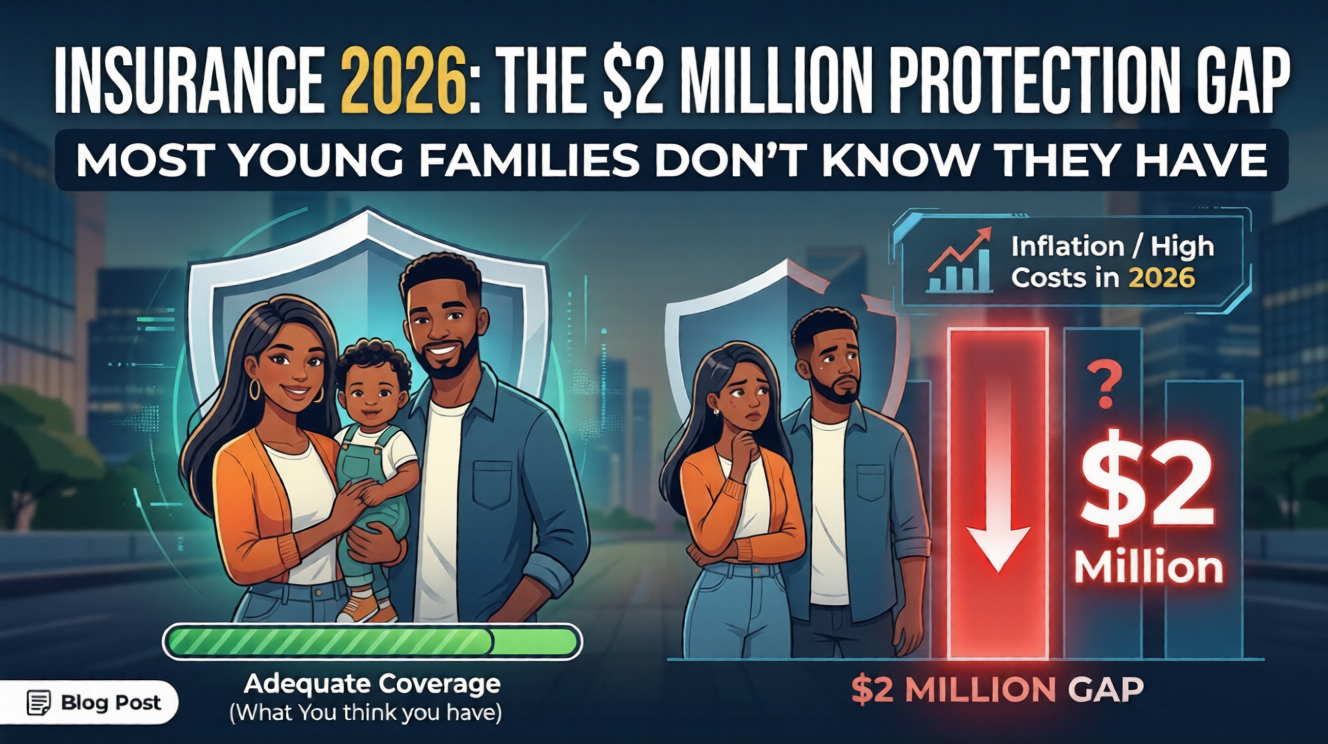
Insurance 2026: The $2 Million Protection Gap Most Young Families Don’t Know They Have
Published: March 8, 2026 | Last Updated: March 8, 2026
GlobesPro4G.com
The $47,000 Funeral and the $0 Bank Account
In 2024, my 34-year-old cousin died unexpectedly. Heart attack. No warning. He left behind a wife, two children ages 4 and 6, and a mortgage.
His life insurance: $50,000 through work.
His debts: $287,000 (mortgage, cars, student loans).
His annual income: $85,000—now gone.
His debts: $287,000 (mortgage, cars, student loans).
His annual income: $85,000—now gone.
The math was brutal. The $50,000 covered funeral costs ($15,000), immediate bills, and 4 months of mortgage. Then nothing. His wife, a part-time teacher, faced impossible choices: sell the home, pull kids from activities, or work multiple jobs while grieving.
This isn’t rare. 40% of Americans have no life insurance. Of those who do, 50% are underinsured by $200,000+ according to LIMRA 2025 data. We’re a nation of families one diagnosis, one accident, one heart attack away from financial catastrophe.
I spent 2025 fixing my own protection gaps. My research revealed most “financial advice” ignores insurance until it’s too late—or pushes overpriced products that benefit agents, not families.
This guide covers every insurance type young families actually need, how to buy it without getting ripped off, and the 2026 strategies that maximize protection per dollar.
Disclosure: This article is for educational purposes only and does not constitute insurance, financial, or legal advice. Insurance needs vary significantly by family structure, income, assets, and risk tolerance. This page contains affiliate links to insurance marketplaces, comparison tools, and financial products. GlobesPro4G.com may receive compensation if you use these links, at no cost to you. We only recommend tools and providers we have researched or used. Insurance policies are contracts—read all terms, exclusions, and conditions before purchasing. Consult a licensed independent insurance agent for personalized advice.
Part 1: The 2026 Insurance Landscape—What’s Changed
The Four Essential Protections
| Insurance Type | Protects Against | 2026 Cost Trend | Priority |
|---|---|---|---|
| Term life | Premature death, income loss | Stable (low rates) | Critical |
| Disability | Inability to work, earn income | Rising (post-pandemic claims) | Critical |
| Health | Medical expenses, bankruptcy | Rising (employer costs up 8%) | Mandatory |
| Umbrella liability | Lawsuits, catastrophic claims | Stable | High for homeowners |
The 2026 reality: Insurance costs are rising, but term life remains historically cheap. Disability claims surged post-2020, making individual policies harder to qualify for and more expensive. Health insurance continues its decades-long climb. The gap between “insured” and “adequately insured” widens.
The Products You Don’t Need (Usually)
| Product | Sales Pitch | Reality | Verdict |
|---|---|---|---|
| Whole life insurance | “Cash value, lifelong protection” | 90% of policies lapse; returns <4%; commissions 50-100% of first year premium | Avoid for protection needs |
| Accident insurance | “Covers what health insurance doesn’t” | Limited scope, duplicate coverage, high profit margins | Rarely worth it |
| Cancer/dread disease | “Lump sum if diagnosed” | Expensive, narrow conditions, better to maximize health/disability | Skip |
| Mortgage life insurance | “Pays off house if you die” | Declining payout, expensive, buy term instead | Never |
| Children’s life insurance | “Locks in rates, future insurability” | Emotional sale, no income to protect, invest the premium instead | Avoid |
Rule: If an insurance product is “sold” not “bought”—if you need convincing—you probably don’t need it. Buy protection against catastrophic, unaffordable losses. Skip products covering inconveniences you could budget for.
Part 2: Term Life Insurance—The Foundation
How Much You Actually Need
| Method | Calculation | Result for $80,000 income, 2 kids |
|---|---|---|
| 10x income | $80,000 × 10 | $800,000 |
| DIME (Debt, Income, Mortgage, Education) | $287k debt + ($80k × 10 years) + $350k mortgage + $200k college | $1,637,000 |
| Human life value | Present value of future earnings | $1,200,000-$2,000,000 |
My recommendation: 10-15x gross income + debt payoff + education funding. For most young families: $1,000,000 to $2,500,000.
2026 example—my policy:
-
Age 32, non-smoker, excellent health
-
$1,500,000, 20-year level term
-
Premium: $42/month ($504/year)
-
Through: Policygenius marketplace, Legal & General America
Term vs. Whole Life—The Math
| Scenario | 20-Year Term | Whole Life (Same Death Benefit) |
|---|---|---|
| Monthly premium | $42 | $1,200 |
| 20-year total paid | $10,080 | $288,000 |
| Death benefit if die year 10 | $1,500,000 | $1,500,000 |
| Cash value year 20 | $0 | $180,000 (projected) |
| Investment alternative | $1,158/month difference in index funds | — |
| 20-year investment value (7%) | — | $570,000 |
Whole life “return”: $180,000 cash value vs. $570,000 if you bought term and invested difference. $390,000 opportunity cost.
Exception: Whole life can make sense for estate planning (>$5M net worth, liquidity for taxes), business succession, or special needs trusts requiring guaranteed payouts. Not for protection-focused young families.
Buying Term Life in 2026—The Process
Step 1: Determine need
-
Income replacement: 10-15x gross
-
Debt payoff: Mortgage, student loans, cars
-
Education: $100,000-$250,000 per child (in-state public to private)
-
Final expenses: $15,000-$25,000
Step 2: Choose term length
-
Until youngest child graduates college: 20-year term
-
Until mortgage paid off: Match mortgage term
-
Until retirement: 30-year term (or ladder multiple policies)
Step 3: Shop marketplace
-
Policygenius: Compares 15+ insurers, instant quotes
-
Term4Sale: No personal info required for quotes
-
Haven Life (MassMutual): 100% online, instant decision for healthy
-
Ladder: Adjustable coverage (increase/decrease without new policy)
Step 4: Medical exam (usually)
-
Height, weight, blood pressure, blood/urine samples
-
20-30 minutes at home or office
-
No-exam options available (higher cost, lower limits)
Step 5: Underwriting and activation
-
2-6 weeks for traditional underwriting
-
1-3 days for accelerated underwriting (healthy, younger)
-
Policy delivered, premiums begin, coverage active
2026 rates (20-year level term, $1,000,000):
| Age | Sex | Health Class | Monthly Premium |
|---|---|---|---|
| 25 | Female | Preferred Plus | $18 |
| 25 | Male | Preferred Plus | $22 |
| 30 | Female | Preferred Plus | $20 |
| 30 | Male | Preferred Plus | $25 |
| 35 | Female | Preferred Plus | $24 |
| 35 | Male | Preferred Plus | $30 |
| 35 | Female | Standard | $38 |
| 35 | Male | Standard | $48 |
Part 3: Disability Insurance—The Forgotten Protection
The Statistics That Should Terrify You
| Risk | Probability by Age 65 |
|---|---|
| Death | 18% |
| Disability (3+ months) | 25% |
| Disability (5+ years) | 12% |
You’re more likely to become disabled than die during your working years. Yet 70% of working Americans lack long-term disability coverage.
The financial impact:
-
6-month disability: Deplete emergency fund, fall behind on bills
-
2-year disability: Exhaust savings, raid retirement accounts, potential foreclosure
-
Permanent disability: Lifetime income loss, dependence on family or government
Employer vs. Individual Disability
| Feature | Employer Group Plan | Individual Policy |
|---|---|---|
| Cost | Often free or subsidized | 1-3% of income ($500-$2,000/year) |
| Taxation of benefits | Taxable (if employer paid premiums) | Tax-free (if you paid premiums) |
| Portability | Lost if you leave job | Portable, guaranteed renewable |
| Definition of disability | “Any occupation” (stricter) | “Own occupation” (broader) |
| Benefit amount | 40-60% of income | 50-70% of income |
| Coverage gaps | Bonuses, commissions often excluded | Can cover total compensation |
The 2026 strategy:
-
Maximize employer coverage (free money)
-
Calculate gap: 60% of base salary ≠ 60% of total compensation with bonus
-
Buy individual policy for “own occupation” coverage, portable, tax-free benefits
My 2025 individual policy:
-
Age 33, software engineer
-
$5,000/month benefit (covers gap after employer 60%)
-
90-day elimination period
-
“Own occupation” definition, to age 65
-
Cost: $1,800/year ($150/month)
-
Provider: Guardian (via independent agent)
Key Disability Policy Features (2026)
| Feature | What It Means | Priority |
|---|---|---|
| Own occupation | Disabled if can’t do your specific job, not any job | Critical for professionals |
| Residual/partial disability | Pays if you can work but at reduced capacity | Important for gradual conditions |
| Cost of living adjustment (COLA) | Benefits increase with inflation | Important for long-term disabilities |
| Future increase option | Can buy more coverage without medical exam | Important for rising incomes |
| Non-cancelable/guaranteed renewable | Insurer can’t cancel or raise rates (except for class) | Essential |
| Mental/nervous limitation | Often limited to 24 months | Try to avoid; negotiate if possible |
Part 4: Health Insurance—The Mandatory Minefield
2026 Options for Young Families
| Source | Best For | Typical Cost (Family of 4) |
|---|---|---|
| Employer coverage | Most stable, employer subsidizes | $400-$800/month employee share |
| ACA Marketplace | Self-employed, between jobs, employer doesn’t offer | $800-$1,800/month (subsidies at <400% FPL) |
| Health sharing ministry | Healthy, religious affiliation, want lower cost | $300-$600/month (not insurance, riskier) |
| Direct primary care + HDHP | Want personalized care, can handle high deductible | $200-$400 (DPC) + $500-$900 (HDHP) |
My 2026 setup:
-
Employer HDHP: $350/month family premium
-
HSA: Maxed $8,550/year family contribution
-
DPC membership: $150/month (optional, for convenience)
-
Effective cost: Lower than PPO option after tax savings
The HSA Strategy—Triple Tax Advantage
| Tax Benefit | How It Works | 2026 Limit |
|---|---|---|
| Deduction | Contributions reduce taxable income | $4,300 individual / $8,550 family |
| Growth | Invested funds grow tax-free | Unlimited growth potential |
| Withdrawal | Qualified medical expenses tax-free | Anytime, or reimburse yourself later |
The stealth retirement account: After 65, HSA funds can be used for any purpose (ordinary income tax, no penalty). Before 65, save receipts, reimburse yourself tax-free in retirement.
2026 family strategy:
-
Max HSA: $8,550
-
Employer contribution: $1,200
-
Net out-of-pocket: $7,350
-
Tax savings (32% bracket): $2,736
-
Effective cost: $4,614 for $8,550 in medical flexibility + investment growth
Part 5: Umbrella Liability—The $2 Million Safety Net
When $500,000 Isn’t Enough
Your auto and homeowners insurance have liability limits—typically $100,000-$500,000. But:
-
Serious car accident: $500,000 medical bills + lost wages + pain and suffering = $1.5M judgment
-
Pool accident at your home: $2M wrongful death settlement
-
Defamation lawsuit (social media): $750,000 judgment
Your insurance pays to its limit. You’re personally liable for the rest. Savings, home equity, future wages—all exposed.
Umbrella Policy Basics
| Feature | Typical Terms |
|---|---|
| Coverage | $1M to $5M+ excess liability |
| Cost | $200-$500/year for $1M (varies by risk factors) |
| Requirements | Max out underlying auto/home liability ($250k-$500k) |
| Covered | Personal injury, property damage, defamation, landlord liability |
| Excluded | Business activities, intentional acts, certain vehicles (boats, ATVs) |
Who needs it:
-
Homeowners (especially with pools, trampolines, dogs)
-
Drivers (especially with teen drivers)
-
Landlords (rental property exposure)
-
Professionals with public profiles (social media risk)
My 2026 policy:
-
$2,000,000 coverage
-
Underlying: $500,000 auto, $500,000 homeowners
-
Cost: $380/year (married, no teen drivers, no pool)
-
Provider: RLI (via independent agent)
Part 6: The 2026 Buying Guide—Avoiding Ripoffs
How to Buy Without Getting Sold
The agent problem: Most “financial advisors” selling insurance are captive agents (work for one company) or independent agents paid by commission. Their incentive: sell you the most expensive product you’ll buy.
The solution:
| Step | Action | Why |
|---|---|---|
| 1 | Calculate need independently | Know what you need before talking to anyone |
| 2 | Shop marketplaces first | Policygenius, Term4Sale, Compare.com—no pressure, transparent |
| 3 | Get 3+ quotes | Prices vary 20-50% for identical coverage |
| 4 | Check insurer financial strength | A.M. Best rating A or better (claims-paying ability) |
| 5 | Read the policy (or key pages) | Exclusions, limitations, renewal terms |
| 6 | Use independent agent for complex needs | Disability, umbrella, business—they access multiple markets |
| 7 | Never buy from cold call, email, or social media ad | High-pressure, often substandard products |
Red Flags—Run Away If You Hear These
| Statement | What It Means | Response |
|---|---|---|
| “Whole life is a great investment” | Agent earns 50-100% commission | “I’ll stick with term and invest the difference” |
| “You need permanent insurance for final expenses” | $15,000 funeral ≠ $500,000 whole life policy | “Term covers that and more for 1/20th the cost” |
| “This disability policy covers you for life” | Read the fine print—often limited to age 65 | “Show me the ‘own occupation’ definition in writing” |
| “You can’t get term after 50” | False; more expensive but available to 70+ | Get quotes; don’t panic-buy permanent |
| “We need to meet in person to discuss” | High-pressure sales environment | “Email me quotes; I’ll call if interested” |
Part 7: The 2026 Action Plan—Protect Your Family in 90 Days
Month 1: Assessment and Immediate Protection
Week 1-2: Inventory current coverage
-
Life insurance: Type, amount, term, beneficiaries
-
Disability: Employer plan details, individual policies
-
Health: Plan type, deductible, out-of-pocket max, HSA eligibility
-
Auto/Home: Liability limits, umbrella existence
Week 3-4: Calculate gaps
-
Life: 10-15x income + debt + education – current coverage = need
-
Disability: 60-70% income replacement – current coverage = need
-
Liability: Net worth + future earnings exposure – current limits = need
Month 2: Purchase Core Protection
Life insurance (if gap >$0):
-
Get 3 quotes via Policygenius or Term4Sale
-
Select 20-30 year level term
-
Complete application, medical exam if required
-
Target: Active coverage by day 45
Disability (if no individual policy):
-
Request quotes from 3 independent agents (Guardian, Principal, MassMutual, Standard)
-
Specify “own occupation,” 90-day elimination, to age 65
-
Target: Active coverage by day 60
Month 3: Optimize and Layer
Umbrella liability (if assets >$500k or children):
-
Max underlying auto/home liability
-
Get $1M-$2M umbrella quotes
-
Target: Active coverage by day 75
HSA optimization (if eligible):
-
Switch to HDHP during open enrollment if not already
-
Set up automatic HSA contributions to max
-
Invest HSA funds (don’t just save in cash)
Beneficiary audit:
-
Update all policies, 401(k), IRA beneficiaries
-
Coordinate with will/trust (if estate planning done)
Frequently Asked Questions (2026 Edition)
Q: Should I buy life insurance on my spouse if they don’t work?
A: Yes, but less. A stay-at-home parent provides $50,000-$100,000/year in value (childcare, household management, transportation). Buy $250,000-$500,000 term to cover replacement costs during working years.
Q: Is group life insurance through work enough?
A: Rarely. Group coverage is usually 1-2x salary, taxable to employer if over $50,000, and lost if you leave. Buy individual term for 10-15x income, use group as supplement.
Q: What if I have health issues and can’t qualify for standard rates?
A: Guaranteed issue policies (no medical exam) available but expensive and limited coverage. Group employer coverage often guaranteed. Buy what you can when healthy—rates lock in.
Q: Should I get long-term care insurance in my 30s?
A: No. Buy in your 50s-60s when risk rises but health is still good. Self-insure until then (HSA funds can pay LTC premiums after 65, or reimburse LTC costs anytime).
Q: What about insurance for my kids?
A: Not needed for income protection. Consider small rider ($10,000) on your term policy for final expenses. Invest the premium you’d spend on child whole life policy in 529 instead.
Q: Can I change my term policy later?
A: Can’t reduce term length, but can usually increase coverage with new policy (new rates based on age/health). Some policies have “conversion” to whole life (usually not worth it).
Conclusion: Insurance Is Not About You
I bought my first term policy at 28, before marriage, before kids. It felt abstract—paying for protection against a death I couldn’t imagine.
At 32, married with a daughter, I increased it. At 34, with a second child, I added disability coverage. Each step felt less like a transaction and more like a promise.
Insurance isn’t for the person who dies. It’s for the people who live—the spouse figuring out how to work and parent simultaneously, the children whose childhood continues despite loss, the family that stays in their home, the future that unfolds with some financial stability intact.
The $42/month for my term policy? That’s not an expense. That’s the price of knowing my family won’t face impossible choices during the worst days of their lives.
Calculate your need. Buy it now, while you’re healthy and rates are low. Then forget about it—until the day you hope never comes, when it becomes the most important financial decision you ever made.
Ready to Protect Your Family?
[Compare Term Life Quotes →]
Policygenius marketplace. 5 minutes, no phone calls, instant estimates.
[Calculate Disability Insurance Needs →]
Guardian, Principal, Standard—request quotes from independent agents.
[Add Umbrella Liability Coverage →]
$1M-$5M excess protection. Often required by auto/home insurers.
Sources & References
-
LIMRA: 2025 Life Insurance Ownership Study
-
Council for Disability Awareness: Long-Term Disability Claims Review
-
Social Security Administration: Disability Statistics
-
A.M. Best: Insurance Company Ratings
-
Kaiser Family Foundation: Employer Health Benefits Survey 2025
-
National Association of Insurance Commissioners: Consumer Resources
-
GlobesPro4G.com personal policy documentation and agent consultations, 2024-2026
Insurance needs are highly individual. Quotes and rates vary by age, health, location, and insurer. Verify all policy terms before purchase.
Important Disclaimers
Insurance Is Not Investment: Life insurance should be purchased for protection, not as an investment vehicle. Cash value life insurance (whole, universal, variable) typically underperforms alternative investments and carries high fees. Buy term insurance for protection, invest the premium difference separately.
Policy Exclusions and Limitations: All insurance policies contain exclusions, limitations, and conditions that affect coverage. Read the entire policy, particularly sections on: suicide (usually excluded first 2 years), pre-existing conditions, war or terrorism, hazardous activities, and alcohol/drug use. Ask your agent to explain any unclear provisions.
Rate Guarantees: Term life policies have “level” premiums guaranteed for the term period (10, 20, 30 years). After the term, rates increase dramatically. Disability insurance policies may be “non-cancelable” (rates fixed) or “guaranteed renewable” (rates can increase for entire class). Understand which you are buying.
Not Personalized Advice: This article provides general education. Your specific insurance needs depend on family structure, income, assets, debts, health status, risk tolerance, and state of residence. Consult a licensed independent insurance agent who can access multiple carriers and provide customized recommendations.
Affiliate Disclosure: GlobesPro4G.com participates in affiliate programs with Policygenius, Haven Life, and insurance comparison platforms. If you request quotes or purchase through our links, we may receive compensation at no cost to you. We only recommend marketplaces with broad carrier access and transparent pricing. Our analysis of insurance types and strategies remains independent.
Claims and Service: The cheapest policy is not always the best. Research insurer claims-paying reputation (NAIC complaint ratios, J.D. Power ratings). An A.M. Best A+ rating indicates strong financial ability to pay claims, but not necessarily good customer service.
About GlobesPro4G.com
GlobesPro4G.com is an independent personal finance platform dedicated to protection-first wealth building. We test insurance products, document claims experiences, and help families secure their financial foundation before building upon it.
Founded 2024. Independently operated. Reader-supported through affiliate partnerships and display advertising.
Contact: contact@globespro4g.com