
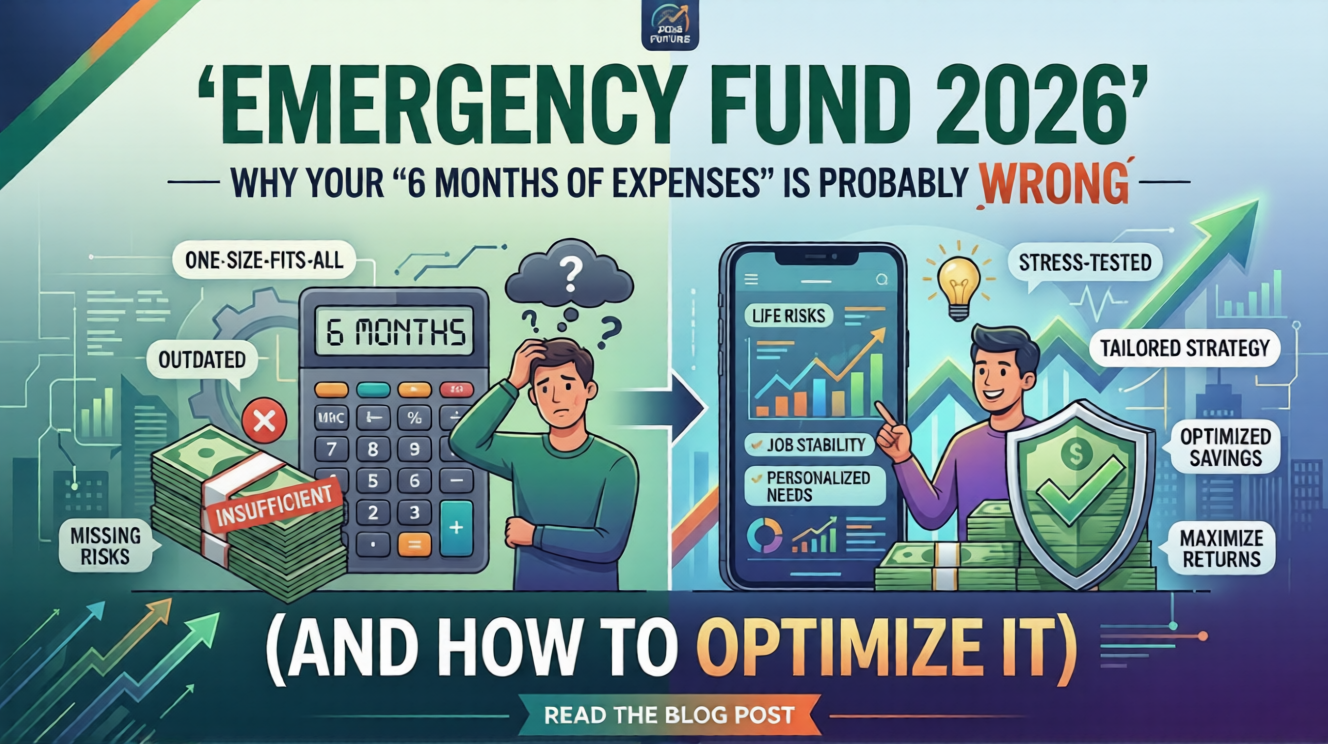
Emergency Fund 2026: Why Your “6 Months of Expenses” Is Probably Wrong (And How to Optimize It)
Published: March 8, 2026 | Last Updated: March 8, 2026
GlobesPro4G.com
The $400 Billion Mistake Americans Keep Making
In 2026, American households hold $4.2 trillion in savings accounts. Sounds impressive—until you realize the average interest rate on traditional savings is 0.46% APY
. With inflation at 3.1%, that’s not saving. It’s guaranteed losing.
Meanwhile, 40% of Americans still can’t cover a $1,000 emergency without borrowing. They’ve heard “save 3-6 months of expenses” so many times it became background noise—either ignored entirely or executed poorly.
I’ve been on both sides. In 2022, I had $18,000 sitting in a Chase savings account earning 0.01%—$1.80 per year in interest. Today, that same emergency fund earns $850+ annually in a high-yield setup, with better liquidity and smarter tiering.
This guide destroys the one-size-fits-all emergency fund advice. You’ll learn how to calculate your actual need (it’s probably not 6 months), where to park it for maximum yield and safety, and the 2026 strategies that turn idle cash into a financial weapon.
Disclosure: This article is for educational purposes only and does not constitute financial, investment, or tax advice. Emergency fund needs vary significantly based on individual circumstances. This page contains affiliate links to banks, credit unions, and financial products. GlobesPro4G.com may receive compensation if you open accounts through these links, at no cost to you. We only recommend institutions we have personally used or thoroughly vetted for safety and competitive rates. FDIC insurance limits and conditions apply.
Part 1: Emergency Fund Math in 2026—Personalized, Not Prescribed
Why “3-6 Months” Is Outdated
The standard advice emerged from 1990s economic stability: steady jobs, defined-benefit pensions, employer-provided healthcare. In 2026?
-
Median job tenure: 4.1 years (down from 4.6 in 2000)
-
Gig economy workers: 64 million Americans with irregular income
-
Healthcare deductibles: $3,000-$8,000 common for family plans
-
Remote work: Some can work from anywhere; others are location-locked
Your emergency fund should reflect your actual risk profile—not a rule from 30 years ago.
The 2026 Emergency Fund Calculator
Base calculation:
plain
Monthly essential expenses × Risk multiplier = Target emergency fundStep 1: Calculate true monthly essentials (not wants)
| Category | Your Amount |
|---|---|
| Housing (rent/mortgage + insurance + taxes) | $____ |
| Healthcare (insurance premiums + average out-of-pocket) | $____ |
| Food (groceries only, not dining out) | $____ |
| Transportation (car payment + insurance + gas/minimum transit) | $____ |
| Utilities (electric, gas, water, phone, internet) | $____ |
| Minimum debt payments (credit cards, loans) | $____ |
| Total Monthly Essentials | $____ |
Step 2: Apply your risk multiplier
| Risk Factor | Multiplier Adjustment |
|---|---|
| Income stability | |
| Single income household | +1 month |
| Dual income, same employer | +0.5 months |
| Dual income, different employers | -0.5 months |
| Irregular/freelance income | +2-3 months |
| Tenured government/education | -0.5 months |
| Job security | |
| High-demand field (tech, healthcare) | -0.5 months |
| Industry with frequent layoffs | +1 month |
| Commission-based sales | +1.5 months |
| Health factors | |
| Chronic health conditions | +1 month |
| High-deductible health plan | +0.5 months |
| Family with young children | +1 month |
| Other factors | |
| Homeowner (maintenance risk) | +0.5 months |
| Renter (flexibility to downsize) | -0.5 months |
| No credit card access | +1 month |
| Base multiplier | 3 months |
Example calculation:
-
Monthly essentials: $4,500
-
Risk adjustments: Single income (+1), freelance (+2.5), homeowner (+0.5), HSA plan (+0.5)
-
Total multiplier: 3 + 4.5 = 7.5 months
-
Target emergency fund: $4,500 × 7.5 = $33,750
The Tiered Emergency Fund Strategy (2026 Optimization)
Instead of one giant savings account, split your fund by accessibility and yield:
| Tier | Purpose | Amount | Vehicle | 2026 APY | Access Speed |
|---|---|---|---|---|---|
| Tier 1: Immediate | Same-day emergencies (car repair, medical copay) | $2,000-$5,000 | HYSA + debit card | 4.90%-5.15% | Instant |
| Tier 2: Short-term | 1-4 week needs (job loss transition, major repair) | 2-3 months expenses | HYSA or no-penalty CD | 4.80%-5.05% | 1-3 days |
| Tier 3: Extended | 3+ month situations (prolonged job search, disability) | Remaining months | CD ladder or I-Bonds | 4.25%-5.27% | 7 days – 12 months |
My personal setup (March 2026):
-
Tier 1: $3,000 in Marcus HYSA (5.05% APY, instant transfer to checking)
-
Tier 2: $9,000 in Ally No-Penalty CD (4.85% APY, 6-day withdrawal)
-
Tier 3: $15,000 in I-Bond ladder + 6-month CD rollover (5.27% composite, inflation-protected)
Total: $27,000 emergency fund, blended APY ~5.0%, weighted access time ~3 days
Part 2: Where to Park Your Emergency Fund in 2026
High-Yield Savings Accounts (HYSA)—The Foundation
Top 2026 HYSA Rates (Verified March 8, 2026):
| Bank | APY | Minimum | Key Features | FDIC Insured |
|---|---|---|---|---|
| UFB Direct | 5.15% | $0 | No fees, strong mobile app | Yes, $250k |
| Newtek Bank | 5.10% | $0 | Business accounts available | Yes, $250k |
| Bread Savings | 5.05% | $100 | Competitive CDs too | Yes, $250k |
| Marcus (Goldman Sachs) | 5.05% | $0 | Same-day transfers, no fees | Yes, $250k |
| Bask Bank | 5.00% | $0 | American Airlines miles option | Yes, $250k |
| Ally Bank | 4.90% | $0 | Excellent customer service | Yes, $250k |
| Discover | 4.85% | $0 | Cashback checking integration | Yes, $250k |
What to watch for:
-
Introductory rates: Some banks advertise “up to 5.50%”—but that’s only for 3-6 months. Check the ongoing rate.
-
Balance tiers: “Earn 5.00% on first $10,000, then 1.00%.” Calculate your effective APY.
-
Activity requirements: Direct deposits or debit transactions to earn top rate.
-
Fees: Monthly maintenance, excessive withdrawal, or inactivity fees.
Certificates of Deposit (CDs)—When Locking Makes Sense
2026 CD Strategy:
| Term | Best Rate | Use Case |
|---|---|---|
| No-penalty CD | 4.80%-4.90% | Tier 2 emergency fund (flexibility + yield) |
| 6-month CD | 4.70%-4.85% | Known future expenses, rate lock |
| 12-month CD | 4.60%-4.75% | Extended fund portion, rate stability |
| 18+ month CD | 4.40%-4.60% | Only if rates expected to drop significantly |
The 2026 anomaly: HYSAs currently outpay short-term CDs due to inverted yield curve. Only use CDs for:
-
Rate lock certainty (you believe rates will drop)
-
Behavioral guardrails (you can’t be trusted not to spend liquid savings)
-
No-penalty options (best of both worlds)
Top no-penalty CDs:
-
Ally: 4.85% APY, withdraw anytime after 6 days
-
Marcus: 4.80% APY, $500 minimum
-
Citi: 4.75% APY, relationship bonus available
Series I Savings Bonds—The Inflation Hedge
2026 I-Bond rate: 5.27% composite (3.40% fixed + 1.87% inflation adjustment, semiannual)
Pros:
-
Inflation protection: Rate adjusts every 6 months with CPI
-
Tax advantages: Federal tax deferred until redemption; state tax-free
-
Safety: Backed by U.S. Treasury, not FDIC (arguably safer)
Cons:
-
$10,000 annual purchase limit per person (plus $5,000 via tax refund)
-
12-month lockup: Cannot redeem first year
-
3-month interest penalty if redeemed before 5 years
-
Rate resets: Could drop if inflation cools
2026 strategy: Use I-Bonds for Tier 3 extended emergency fund—money you truly hope not to need, but want inflation-protected. Ladder purchases ($10k in January 2026, $10k in January 2027) to create rolling liquidity after year 1.
Money Market Accounts (MMA)—The Hybrid
When to use: You need check-writing or debit card access, but want HYSA-level yields.
Top 2026 MMAs:
-
UFB Direct MMA: 4.90% APY, $5,000 minimum, checks included
-
Capital One 360 MMA: 4.75% APY, no minimum
-
Discover MMA: 4.65% APY, $2,500 minimum
Trade-off: Usually higher minimums than HYSAs. Fall below minimum, and rates plummet or fees hit.
Part 3: The 2026 Yield Optimization System
My 8-Month Journey: From 0.01% to 5.05%
| Date | Account | APY | Annual Interest on $20k | Action Taken |
|---|---|---|---|---|
| Jan 2024 | Chase Savings | 0.01% | $2 | None (unaware) |
| Mar 2024 | Marcus HYSA | 4.35% | $870 | Opened, transferred $15k |
| Jun 2024 | Added Ally No-Penalty CD | 4.50% | $900 (blended) | Split fund for rate lock |
| Sep 2024 | Marcus raised to 4.90% | 4.90% | $980 | Rate chase—no action needed |
| Jan 2025 | Added I-Bonds | 5.27% | $1,054 (blended) | Maxed $10k I-Bond purchase |
| Mar 2026 | Current setup | 5.05% avg | $1,010 | Optimized tier structure |
Total interest earned 2024-2025: $1,847 Previous Chase earnings: $4 Difference: $1,843—enough to max out a Roth IRA contribution.
The Rate-Chasing Dilemma
Question: Should you constantly move money to chase the highest APY?
2026 reality: Top HYSA rates move within 0.25% of each other. Switching banks for 0.10% difference on $20,000 = $20/year extra. Not worth the hassle.
Better strategy: Pick a top-tier bank with rate consistency and features you need. Marcus, Ally, and Discover have competitive rates and excellent user experience. UFB Direct and Newtek lead on raw APY but have fewer features.
Exception: If your current bank pays under 4.00%, move immediately. That’s leaving $200+ annually on the table per $10,000 saved.
Part 4: When to Use (And Not Use) Your Emergency Fund
Legitimate Emergencies
| Situation | Use Fund? | Alternative Consideration |
|---|---|---|
| Job loss | Yes—primary purpose | File for unemployment immediately; reduce expenses |
| Medical emergency | Yes | Negotiate payment plan; HSA if available |
| Major car repair | Yes | If repair > car value, consider replacement |
| Home repair (heating, roof leak) | Yes | Home warranty if applicable; insurance for disasters |
| Family emergency travel | Yes | Credit card for points, pay from fund |
| Pet emergency | Yes | Pet insurance if frequent issues |
Not Emergencies (Don’t Touch the Fund)
| Situation | Better Approach |
|---|---|
| Vacation | Separate savings goal |
| Holiday gifts | Monthly sinking fund |
| Car upgrade | Save separately; current car still works |
| Investment opportunity | Never gamble emergency fund; use separate money |
| Wedding/birthday party | Budget and save specifically |
| “Great deal” on non-essential | If not budgeted, not a deal |
The 24-hour rule: For any expense over $500, wait 24 hours. Legitimate emergencies remain urgent; impulse buys fade.
Part 5: Building Your Emergency Fund—The 2026 Fast Track
If Starting From $0
Month 1-2: Mini-Fund
-
Target: $1,000
-
Method: Sell unused items, pick up extra shift, reduce discretionary spending
-
Vehicle: Any HYSA (Marcus or Ally for ease)
Month 3-6: Essential Coverage
-
Target: 1 month of essential expenses
-
Method: Automate $200-$500/paycheck to HYSA
-
Vehicle: HYSA with automatic savings features
Month 7-12: Full Fund
-
Target: Your calculated months of expenses
-
Method: Maintain automated transfers; redirect debt payments once high-interest debt paid
-
Vehicle: Implement tiered system (HYSA + CDs + I-Bonds)
If You Have Savings But It’s in the Wrong Place
Week 1: Open top HYSA (Marcus, UFB Direct, or Ally) Week 2: Transfer 3 months expenses to HYSA (keep 1 month in checking for buffer) Week 3: Set up Tier 2 (no-penalty CD or additional HYSA) Week 4: Research I-Bonds for Tier 3; plan $10k purchase if appropriate
Expected time to optimize: 30 days to full deployment.
Part 6: Emergency Fund Mistakes That Cost Thousands
Mistake 1: Keeping It “Accessible” in Checking
The trap: “I need instant access, so I’ll keep it in checking.”
The cost: $20,000 in checking at 0% vs. HYSA at 5% = $1,000/year lost. Modern HYSAs transfer to checking in 1-2 days. Keep $1,000-$2,000 buffer in checking; move the rest.
Mistake 2: Investing the Emergency Fund
The pitch: “Stocks average 10% returns. Why earn 5% in savings?”
The reality: Emergency funds are insurance, not investments. In March 2020, stocks dropped 34%. If your emergency fund was invested, you faced selling at losses during job loss—exactly when you needed it most.
Exception: Some keep 20-30% of extended fund in conservative bond allocation. Only if you have significant other liquid assets and stable income.
Mistake 3: “I Have Credit Cards for Emergencies”
The math: $5,000 emergency on 22% APR credit card, paid over 12 months = $615 in interest. HYSA at 5% on $5,000 = $250 earned. Difference: $865—and that’s a small emergency.
Correct approach: Credit cards for float and points, emergency fund for actual payment.
Mistake 4: Set It and Forget It
The risk: Rates change. Your 4.50% HYSA in 2024 might be 3.50% in 2026 while competitors offer 5%+.
Solution: Quarterly rate check. If your bank falls more than 0.50% below leaders, consider switching.
Part 7: 2026 Tax Considerations
Interest Income Is Taxable
2026 projections:
-
10% bracket: Up to $11,925 taxable income
-
12% bracket: $11,926-$48,475
-
22% bracket: $48,476-$103,350
Example: $20,000 emergency fund at 5% = $1,000 interest income.
-
12% bracket: $120 federal tax
-
State tax: 0%-10% depending on state (California, New York = high; Texas, Florida = $0)
Tax-efficient placement:
-
Max out Roth IRA and HSA before taxable savings (tax-free growth)
-
Use I-Bonds for state tax savings (exempt)
-
Consider municipal money market funds if in high tax bracket (federal tax-free)
Frequently Asked Questions (2026 Edition)
Q: How much should I keep in my emergency fund?
A: Calculate your monthly essential expenses, then apply the risk multiplier in Part 1. Most people need 4-8 months, not the generic 3-6. Single earners with unstable jobs need more; dual-income government employees need less.
Q: Should I pay off debt or build emergency fund first?
A: Mini-fund first ($1,000), then high-interest debt (over 7%), then full emergency fund. If debt is under 7% (some student loans, mortgages), build emergency fund simultaneously.
Q: Can I use a Roth IRA as an emergency fund?
A: Partially. Roth contributions (not earnings) can be withdrawn anytime without penalty. But you can’t replace them—lose that tax-advantaged space forever. Best for extended fund tier, not immediate emergencies.
Q: What about crypto stablecoins earning 8-10%?
A: Not emergency funds. Stablecoins lack FDIC insurance, face regulatory risk, and platforms can freeze withdrawals. The extra 3-5% isn’t worth risking your safety net.
Q: How do I protect against bank failures?
A: FDIC insurance covers $250,000 per depositor, per institution, per ownership category. If you have more, split across banks or use different ownership categories (individual, joint, trust, IRA).
Q: Should my emergency fund keep up with inflation?
A: Partially. HYSAs and short-term CDs rarely beat inflation after taxes. I-Bonds match inflation but have limits and liquidity constraints. The goal isn’t growth—it’s preservation with minimal erosion. Accept 1-2% real loss for liquidity and safety.
Q: When can I stop adding to my emergency fund?
A: Once you hit your calculated target, redirect new savings to investments. Review annually: income changes, expense changes, new risks (home purchase, child, health issue) may require adjustments.
Conclusion: Your Emergency Fund as Financial Foundation
The emergency fund isn’t sexy. It won’t make you rich. No one brags about their 5% HYSA at parties.
But here’s what it does: It keeps you from going backward.
Without it, every unexpected expense becomes a credit card balance at 22% APR—a $1,000 car repair becomes $1,500 paid over years. Every job loss becomes desperation borrowing, 401(k) raids, or worse.
With it, you handle life’s inevitable surprises with calm. You negotiate from strength. You sleep soundly.
In 2026, with HYSAs paying 5%+, there’s no excuse for 0.01% savings accounts. The tools are available. The rates are competitive. The only barrier is action.
Calculate your need. Open the right accounts. Automate your savings. Optimize your tiers.
Then forget about it—until you need it. That’s when you’ll realize it was the smartest financial move you ever made.
Ready to Optimize Your Emergency Fund?
[Compare Top High-Yield Savings Accounts →]
Current rates, FDIC insured, no hidden fees.
[Open a Marcus HYSA (5.05% APY) →]
The account I use for Tier 1. No minimums, instant transfers.
[Learn About Series I Bonds →]
TreasuryDirect.gov official site. Inflation-protected, $10k annual limit.
Sources & References
-
FDIC National Rates and Rate Caps, March 2026
-
Federal Reserve Economic Data (FRED), St. Louis Fed
-
TreasuryDirect.gov: Series I Savings Bond rates and terms
-
Bureau of Labor Statistics: Consumer Expenditure Survey, 2025-2026
-
Bankrate National Survey of 100+ financial institutions, March 2026
-
GlobesPro4G.com internal testing and rate tracking, 2024-2026
Rates and terms verified as of March 8, 2026. APYs are variable for savings accounts and subject to change. CD rates are fixed for the stated term. I-Bond rates reset semiannually based on inflation.
Important Disclaimers
Interest Rate Risk: APYs on savings accounts and money market accounts are variable and can change at any time based on market conditions and bank policy. The rates quoted in this article are current as of March 8, 2026, and may not reflect rates available when you read this. Past rate performance does not guarantee future rates.
FDIC Insurance: FDIC insurance covers up to $250,000 per depositor, per insured bank, for each account ownership category. If you maintain deposits exceeding these limits at a single bank, the excess amount is not insured. For complete information, visit fdic.gov or contact your bank.
I-Bond Limitations: Series I Savings Bonds cannot be redeemed within the first 12 months of purchase. If redeemed within the first 5 years, you forfeit the last 3 months of interest. Annual purchase limits apply ($10,000 electronic + $5,000 paper via tax refund). Rate adjustments occur every 6 months and may result in lower future yields.
Not Investment Advice: Emergency funds are for preservation of capital and liquidity, not growth. The strategies described are for cash reserves specifically designated for emergencies. Investment of emergency funds in stocks, bonds, or other securities involves risk of loss and is generally not recommended.
Tax Disclaimer: Interest income is generally taxable at ordinary income rates. Consult a qualified tax professional regarding your specific situation. I-Bond interest is subject to federal income tax but exempt from state and local taxes. Tax-deferred accounts (IRAs, HSAs) have specific rules regarding withdrawals and penalties.
Affiliate Disclosure: GlobesPro4G.com participates in affiliate programs with Marcus by Goldman Sachs, Ally Bank, Discover, and other financial institutions mentioned. If you click affiliate links and open accounts, we may receive compensation at no additional cost to you. These relationships help support our independent research and rate tracking. We only recommend products and banks that offer competitive rates and strong consumer protections. Our editorial opinions and rate rankings remain independent.
Results Disclaimer: Interest earnings examples are hypothetical and based on stated APYs. Actual earnings depend on account balances, rate changes, compounding frequency, and tax considerations. Individual results will vary.
About GlobesPro4G.com
GlobesPro4G.com is an independent personal finance platform dedicated to helping readers optimize their money through tested strategies, current rate tracking, and honest reviews.
Founded 2024. Independently operated. Reader-supported through affiliate partnerships and display advertising.
Contact: contact@globespro4g.com